Home
Contact

 Gardening

About

Ways of Living

Social Change

Projects

Publications

Introduction

'Ignorance is the first thing you need before you can create a great garden.' Charles Jencks

This is an age when we no longer wish to judge people merely by their appearance, yet we still do so with gardens. Most gardeners and garden designers aim to create visual splendour without considering the deeper meanings that a garden can have. I am interested in the revival and reinvention of symbolic garden design.

I have been researching the subject for several years and have embarked upon gardening projects that attempt to put my ideas into practice. Although I have obtained the RHS General Certificate in Horticulture and worked as a gardener at Lady Margaret Hall, Oxford University, I am not an expert plantsman. In creating my garden designs I always work in association with plant experts and ecological advisors.

I have also recently completed what I believe to be the world's first gardening hijack novel.

The history of symbolic garden design

Look around most of our own gardens today and you're unlikely to find much symbolism. In fact, since around 1700 gardens in Europe have been largely devoid of allegory and metaphor. Instead gardens are more for pleasure and beauty. We aim to create harmonious combinations of flower colours and foliage textures. We want plants of different heights and shapes. We desire visual splendour in the garden throughout the year. The emphasis is on the senses, especially visual impressions. But this is not the only way to think about garden design...

The idea of symbolic garden design has its origins in ancient civilisations. Thousands of years ago the Persians invented the 'Paradise Garden'. To enter the garden you would have to cross water channels, which represented the four rivers of heaven. Once inside you would find a profusion of fruit trees, symbolic of the fruits of the earth created by God.

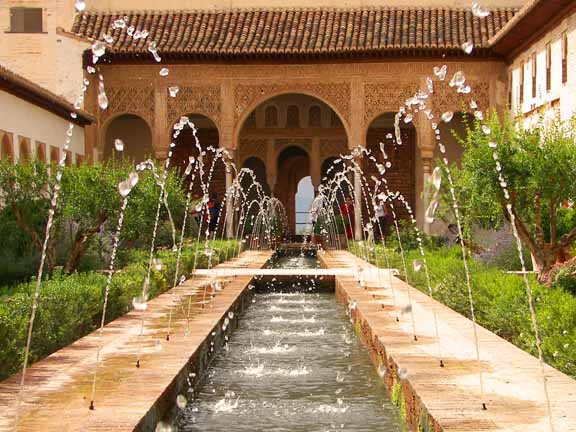
The Alhambra in Granada, which is based on Islamic garden principles

The daisen-in zen garden in Kyoto

Chinese gardens were also full of allegory and meaning. One hundred years before the birth of Christ, the Han Emperor Wei designed a parkland containing artificial lakes and islands to represent an old myth about the dwelling places of immortal beings. In Japanese Zen gardens, rocks were chosen and placed to symbolise man's passage through the world to eternity. In medieval Europe, too, the plain green lawns in monastic cloisters were considered an important source of spiritual refreshment and contemplation, and symbolised renewal and everlasting life. The design of the renaissance garden of the Villa Lante in Italy represents the tale of humanity's descent from the Golden Age, based on Ovid's Metamorphosis.

In the Victorian 'Language of Flowers', adopted from an earlier Turkish tradition, flowers were used to symbolise feelings. The meaning of each flower was often based on stories from Greek mythology, Biblical tales or ancient folklore. Examples include snowdrops as a symbol of hope, garden chervil for sincerity, bittersweet for truth, broom for humility, orange trees for generosity and rudbeckia for justice. Some plants had more negative associations: scarlet Auricula for greed, Agnus castus for indifference, and cherry trees for deception.

The Villa Lante renaissance garden, based on Ovid's Metamorphosis

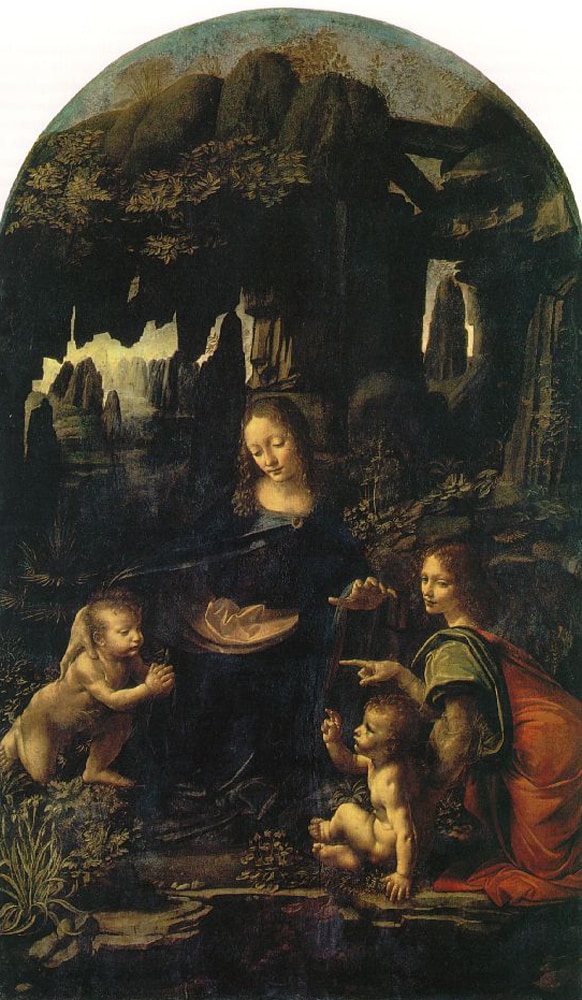
Leonardo Da Vinci's Virgin of the Rocks (Louvre version) contains extensive use of symbolic flowers such as the columbine (representing the Holy Ghost)

A related approach is the creation of Shakespeare Gardens - popular in the United States - which contain plants mentioned in the plays. The plants often have symbolic meanings, as in Ophelia's speech in Hamlet: 'There's rosemary, that's for remembrance. Pray you, love, remember. And there is pansies, that's for thoughts.'

Symbolic gardens have occassionally appeared at the Chelsea Flower Show. Sir Terence Conran's Peace Garden commemorated the 60th anniversary of the end of World War II. Plants were selected for their symbolism of peace, war or remembrance, with a predominance of white flowering plants and a scattering of scarlet poppies. Water flowed over a stone wall with the word 'peace' written on it in different languages and each pebble in the pool represented a life lost in the war.
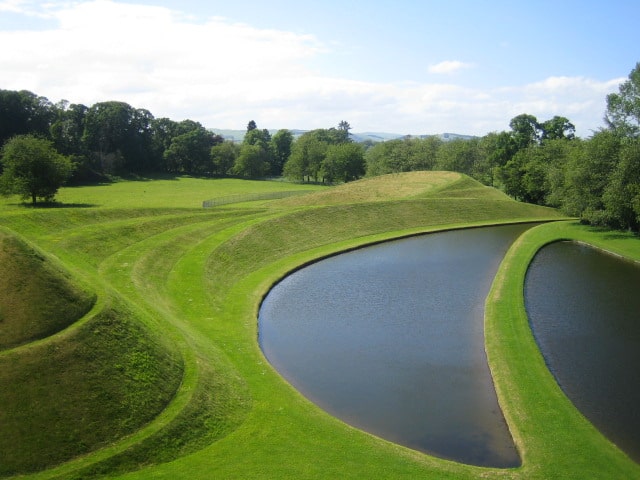
The most important contemporary example is Charles Jencks's 'Garden of Cosmic Speculation' in Dumfriesshire, Scotland, which has a DNA garden that is taking symbolic garden design into the future. It contains a series of six cells and in each there is a different kind of idea, which is symbolised by the planting. 'The planting is subordinate to the design,' he says, 'but completes it and fills it out.'

Charles Jencks's Garden of Cosmic Speculation

These recent examples are exceptions. Contemporary garden design remains obsessed with the visual.

Why create a symbolic garden?: An imaginary dialogue (1)

-The English have an extraordinary passion for gardening. It's something I admire very much, their love of nature and living things.
-Go on, I said, knowing that his criticisms of people were often preceded by initial praise.
-The problem is that most gardeners are obsessed with what their gardens look like. They're interested in ensuring that their mixed border has the perfect colour combination, or that their lawn is exactly one inch high, or that their garden contains a harmonious balance between shrubs and perennials, or that they have plants with unusual flowers or 'winter interest'. Four hundred years ago Francis Bacon wrote, 'nothing is more pleasant to the eye than green grass kept finely shorn'. Attitudes haven't really changed since then. For the gardeners of England, gardening is mostly about creating a pretty picture.
-Take it easy, Gerry. What's wrong with having a beautiful garden, or appreciating what something looks like?
-It's that.
-My mother loved the varying hues of camellia flowers.God, it's been years since I thought about that. Camellias were her favourite.
I was sorry to have butted in. Gerry's face looked old, his skin too translucent. He paused a moment, then, with effort, pushed himself out of his chair and reached up for a book on a nearby shelf. He passed it to me. It was a study of Picasso's painting of the bombing of Guernica in 1937. After I'd flicked through it, he replied,
-Look Roman. Nineteenth century painters depicted the world as it appeared to them, visually. That was the essence of realism and impressionism. A portrait of a person looked like the person. Constable's Hay Wain looks like a real hay wain. But twentieth-century artists like Picasso were revolutionaries because they realised that art didn't have to be about creating beautiful images that represented the visible world or some imagined form of it. For cubists, surrealists, abstract artists and all that lot, conveying ideas became more important than visual impressions. They might use blocks of colour or lines to represent concepts such as alienation, or strange distorted faces and symbols to suggest the horrors of war, as Picasso did. Since the invention of cubism, the specific appearance of a given landscape has not been the aim of any important painter.

Gerry was so articulate. He always sounded convincing.

-I thought we were talking about gardening, not art.
-Don't you get it? English gardens are like nineteenth century paintings, focusing on visual impressions rather than symbolism and meaning. They don't attempt to convey ideas. No offence to the memory of your mother, but the majority of gardeners are preoccupied with creating pretty pictures with pansies and roses. Camellias too. Gardening hasn't yet become a modern art form. It remains an anachronism.

I contemplated Gerry's words as I wandered home through the park. I wasn't sure I agreed with him. Creating visual beauty, it seemed to me, was one of the few things humans did that wasn't destructive or offensive. It was something to celebrate, not condemn. And in any case, gardeners didn't limit themselves purely to the visual elements. They planted lavender because of its scent. Or they designed their garden to produce a sense of peace and tranquillity. I also wondered about Gerry's views on symbolic art. Surely it wasn't a twentieth century invention. Anybody who had read The Da Vinci Code knew that Leonardo's paintings were full of metaphor and meaning.

Continuing my walk through the drizzle I passed by a gardener on her knees planting ready-grown pansies into an annual bed. This ritual took place year after year. Probably cost the park a fortune. I imagined what Gerry would have commented if he had found the strength to accompany me. A waste. A meaningless and temporary flash of colour for the masses. A distraction from reality. Bread and circuses.

Why create a symbolic garden?: An imaginary dialogue (2)

The garden world is changing with the recent return to the days of symbolic planting. Across the country people have been thinking more about what they want their gardens to mean, both to themselves and to other people. Following is a transcript from an interview for radio I did with Anna Petalin, who has been redesigning her garden near the South Downs in Sussex:

[rustle of leaves blown gently by wind, distant call of a blackbird]

RK: I'm here in the garden of Anna Petalin, a retired librarian with a passion for roses. Anna, your garden is looking beautiful at the moment. There is quite a variety of roses here in the main border. What makes them special?

AP: Well, I've been taking out a lot of my old roses and putting in new ones that actually say something important.

RK: What exactly do you mean?

AP: I suppose my thinking started to change when a friend of mine asked me why I had so many roses with rather aristocratic or monarchy-related names yet I professed to be republican and egalitarian! You see, my garden was full of popular roses such as Queen Mother, Princess Michael of Kent, Duchess of Montebello and Duc de Guiche. It had never occurred to me to think about the message conveyed in my planting design! So I decided to take them out.

RK: But you've still got a lot of roses here.

AP: That's right. It was difficult to decide what to replace them with. I've loved roses since I was a child so had no intention of giving them up altogether. What I did was go through a plant encyclopaedia and find all those roses with names that were closely related to my beliefs, character and hopes. So now I've planted Rosa 'Compassion' and Rosa 'Freedom', both of which represent ideas that are important to me. Also, I've always admired people who are curious about the world and others and was hoping to find a rose called 'Curiosity'. But nobody seems to have bred one yet so I had to settle for Rosa 'Fascination' as the next best thing!

RK: Down here in the corner of the garden you have a couple of rambler roses climbing over a wooden arbour, which contains two seats in it. And above the entrance there's a piece of wood with a rose carved on it. Is this also part of your symbolic garden?

AP: It certainly is, Roman. The arbour's my favourite place in the garden. I've actually planted the ramblers in honour of my favourite writer, George Orwell. He once wrote about planting some sixpenny rambler roses from Woolworths in the 1930s. Apparently a reader wrote him an indignant letter saying roses are bourgeois. Orwell replied that his money was better spent than if it had gone on cigarettes or radical political pamphlets! I admire him because he was willing to challenge fashionable opinions and tried to learn about other people's lives from experience rather than books, like when he lived down and out on the streets of London.

RK: What about the carving over here?

AP: In medieval Europe a rose carving or design in a room commonly symbolised that whatever was said there would be in confidence or kept secret. There's a Latin phrase for it, 'sub rosa', which literally means 'under the rose'. You can find these roses above doorways and on ceilings in old meeting rooms and libraries. I had this idea to create a 'sub rosa' arbour, which would be a place to have intimate conversations with family and friends, where you might confide in someone or listen to their problems or share some special thought with them.

RK: It certainly does look like a fantastic place to sit down and talk. Perhaps we should try it out!

[Sound of two people settling themselves into chairs]

© 2007 Roman Krznaric
Creative thinking about the art of living and social change